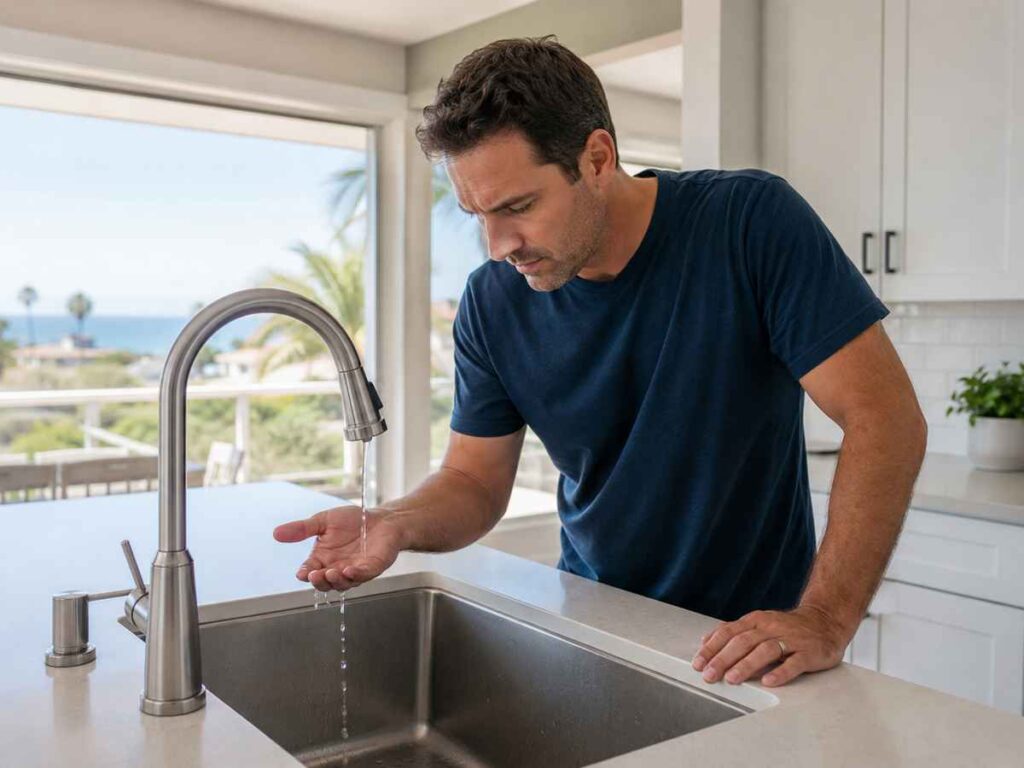
If you are searching for What to Do When Your Water Pressure Suddenly Drops to a Trickle, start by checking whether the change affects one fixture or every faucet and shower in your home.
In San Diego, CA, we help homeowners diagnose water pressure concerns, including pressure regulator issues, restricted valves, fixture buildup, supply line concerns, and plumbing leaks.
When water pressure changes throughout the entire house at once, the water pressure regulator, also called a pressure reducing valve or PRV, deserves special attention.
A sudden change from strong water flow to a light trickle usually means something in the water supply path has changed.
The fastest way to find the source is to determine how much of the plumbing system is affected and then work backward from the fixtures toward the main water supply.
Quick Answer: What Should You Check First?
When your home suddenly has very low water pressure, check these things in order:
- Test several faucets and showers.
- Compare cold water with hot water.
- Ask whether nearby homes have the same pressure change.
- Confirm that your accessible main house shutoff valve is fully open.
- Check recently serviced water filters, softeners, or other equipment.
- Look for signs of water movement when every fixture is turned off.
- Test household water pressure with a pressure gauge.
- Consider the water pressure regulator if the entire home has weak flow.
If every fixture changed at approximately the same time while neighboring properties still have normal water pressure, the PRV becomes one of the most useful components to investigate.
First Determine Whether the Pressure Change Is Local or House Wide
Before looking for the water pressure regulator, perform a simple test around your home.
Turn on the cold water at your kitchen sink.
Next, test a bathroom faucet.
Then test a shower.
If your home has an outdoor hose connection, check that as well.
This simple comparison tells you whether you are dealing with a fixture issue or a larger water supply issue.
Low Pressure at Only One Faucet
When only one faucet has weak water flow, the whole house pressure regulator is usually not the first place to look.
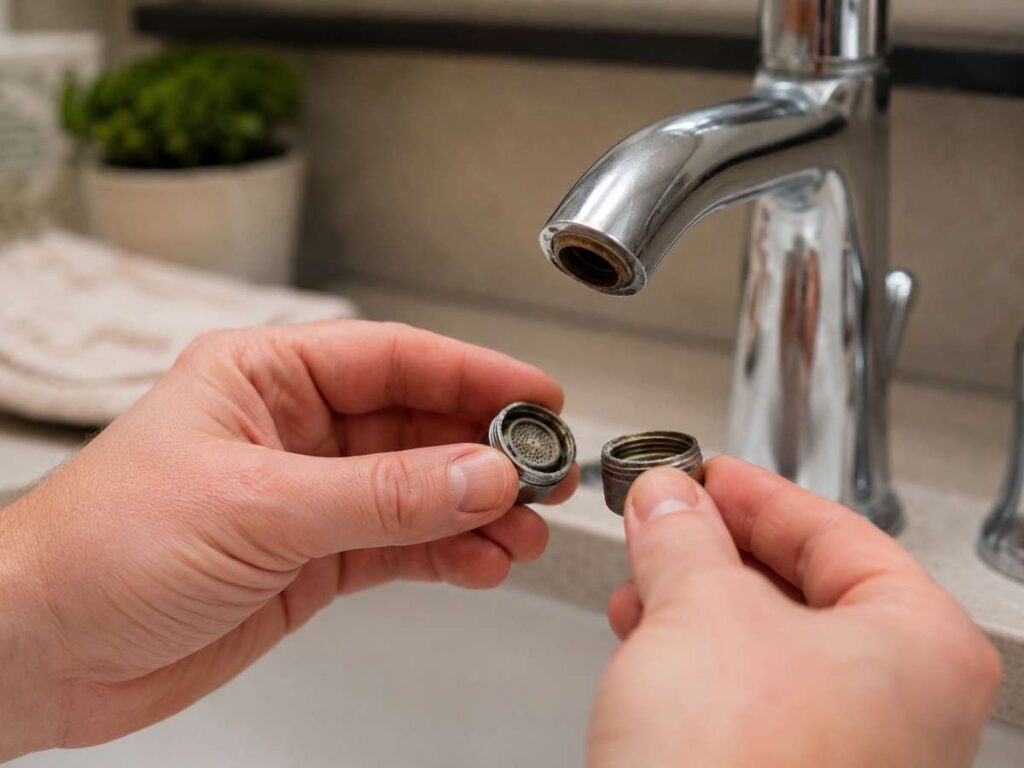
Common causes include:
- Mineral deposits inside the faucet aerator.
- Debris inside the faucet cartridge.
- A partially open fixture supply valve.
- Scale inside the showerhead.
- A restriction in the individual fixture supply line.
Faucet aerators contain small openings that can collect sediment and mineral deposits. Removing and cleaning the aerator can often restore normal flow when only one faucet is affected.
The same principle applies to a showerhead. If every other fixture has normal flow, start with the showerhead rather than the main plumbing system.
Low Water Pressure Only on the Hot Water Side
If cold water has normal pressure but hot water comes out slowly, the PRV is less likely to be the source because the regulator controls water entering the home before it is divided into hot and cold plumbing.
Instead, examine components associated with the hot water system.
Possible sources include:
- A water heater shutoff valve that is not fully open
- Sediment near a water heater connection
- A restricted flexible connector
- A mixing valve restriction
- A tankless water heater inlet screen that needs service
- A restriction somewhere in the hot water piping
Testing the hot and cold sides separately is therefore one of the easiest ways to narrow the diagnosis.
When the Entire House Suddenly Has Low Water Pressure
If the kitchen faucet, bathrooms, showers, toilets, outdoor faucets, washing machine, and other fixtures all seem weaker, focus on components shared by the entire plumbing system.
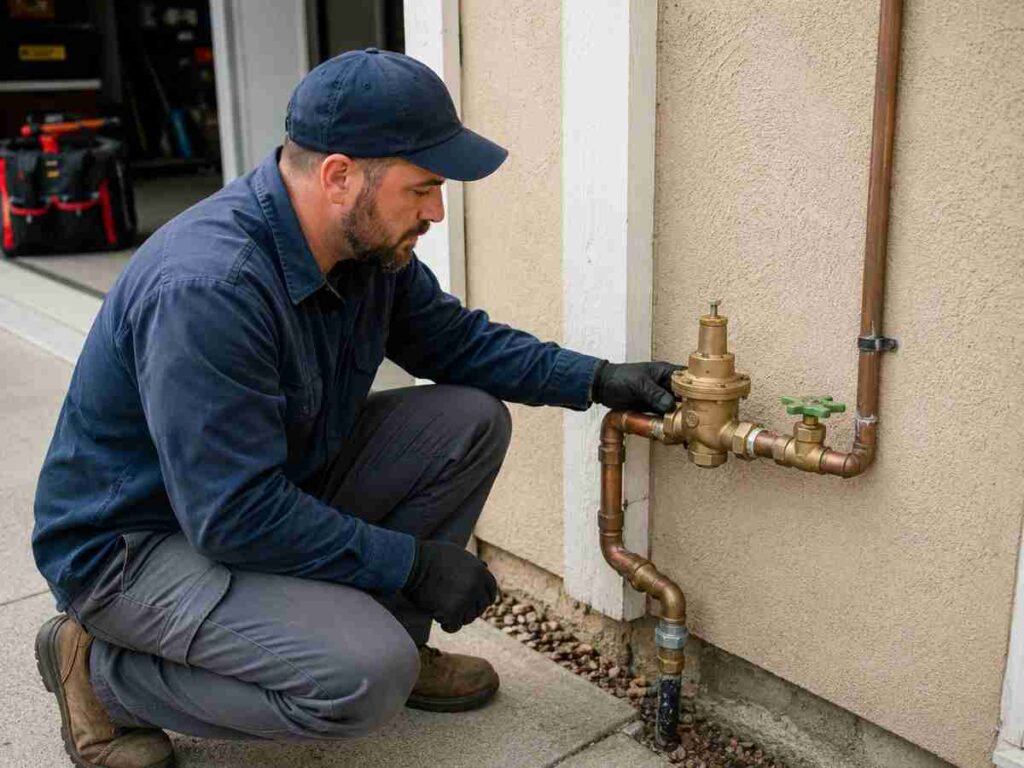
These include the:
- Municipal water supply.
- Water meter connection.
- Main water service line.
- Main house shutoff valve.
- Water pressure regulator.
- Whole house filtration equipment.
- Main distribution piping.
A restriction at any of these points can influence water flow throughout the property.
For San Diego homeowners, the pressure regulator deserves particular attention because water pressure varies throughout the city according to location and system demand.
Local public utility guidance also states that a regulator is required where area water pressure exceeds 80 PSI and that the regulator is the property owner’s responsibility.
Why the Water Pressure Regulator Matters So Much in San Diego
A water pressure regulator sits between the municipal water supply and your household plumbing.
Its purpose is simple.
Street water may arrive at a pressure higher than your home’s plumbing needs. The PRV reduces that incoming pressure and provides a more consistent household pressure.
The City of San Diego specifically explains that a regulator can restrict water flow if it becomes positioned internally toward the closed side. The same local guidance recommends having the regulator inspected when this occurs.
That makes the PRV especially relevant when water pressure was comfortable previously and then changes throughout the entire home.
What Is a Pressure Reducing Valve?
The pressure reducing valve, commonly shortened to PRV, is a mechanical valve installed on the incoming water line.
A typical residential PRV contains components such as:
- A spring
- A diaphragm
- A valve seat
- An adjustment mechanism
- An internal water passage
The spring and diaphragm respond to water pressure and control how widely the internal valve opens.
When everything is working correctly, incoming pressure is reduced to a stable level before water reaches your faucets, toilets, showers, water heater, dishwasher, refrigerator, washing machine, and other plumbing fixtures.
How Can a PRV Cause Water to Slow to a Trickle?
A pressure regulator does more than reduce PSI. Water must also pass through the valve.
If the internal opening becomes restricted, the regulator can limit the amount of water moving into the house.
Several conditions can influence PRV performance over time.
Internal Mineral Deposits
Mineral particles can collect around moving parts and water passages.
A small amount may have little effect. Greater accumulation can limit the valve’s ability to respond freely.
Sediment or Debris
Material entering through the water service can occasionally collect inside a regulator.
A San Diego County pressure regulator replacement case documented extremely low household water pressure where buildup and small material were found inside the old regulator, with normal pressure returning after the regulator was replaced.
Diaphragm and Spring Wear
The internal spring and diaphragm continuously respond to pressure changes.
As these components age, their response can become less consistent.
Restricted Valve Position
A regulator can become mechanically restricted toward a lower flow position.
When this happens, opening additional faucets may make the change particularly noticeable.
The Important Difference Between Water Pressure and Water Flow
This distinction is extremely useful when troubleshooting a home.
Water pressure measures force and is normally expressed in PSI.
Water flow measures how much water moves through the plumbing during a period of time.
They are related, but they are not identical.
Imagine a garden hose connected to a valve that is almost closed. Pressure can still build inside the hose when no water is being used. Once you open the nozzle, however, the restricted valve cannot provide enough water volume.
Your household plumbing can behave similarly.
A pressure gauge might show a reasonable static reading when every faucet is closed, yet the shower can still become weak when another fixture opens.
That pattern suggests a flow restriction rather than simply a low static pressure setting. A restricted PRV, main valve, filter, or older pipe can create this behavior.
This is why one pressure gauge reading should not be treated as the entire diagnosis. Testing pressure while water is being used can provide additional information about how the system performs under demand.
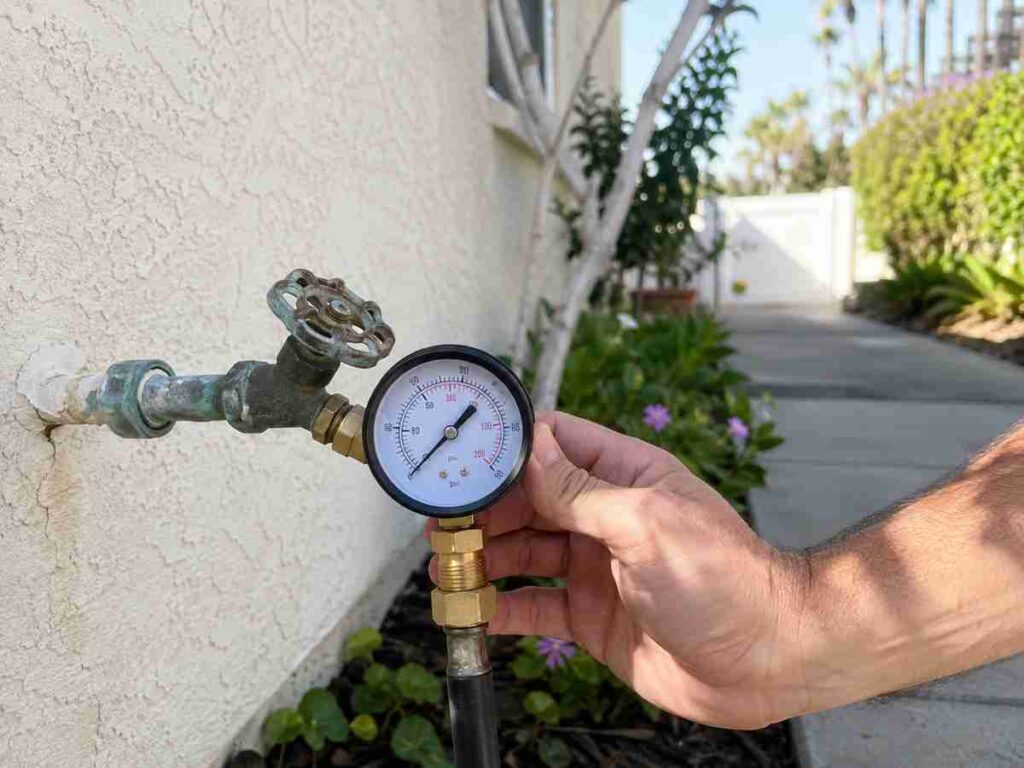
How to Test Your Home’s Water Pressure
A basic water pressure gauge can provide useful information without opening the plumbing system.
Choose a gauge designed to connect to a standard outdoor hose bib.
Step 1: Turn Off Water Using Fixtures
Make sure faucets, showers, irrigation, washing machines, dishwashers, and other water using equipment are inactive.
This allows you to measure static water pressure.
Step 2: Choose a Suitable Hose Bib
Select an outdoor hose bib that represents the household water supply as closely as practical.
A connection relatively close to where water enters the home can provide a useful reading.
Step 3: Attach the Pressure Gauge
Connect the gauge securely according to its instructions.
There should be a proper seal at the connection.
Step 4: Open the Hose Bib
Open the faucet completely and allow the gauge needle to stabilize.
Record the PSI reading.
Step 5: Repeat the Reading
Repeating the test helps confirm that the result is consistent.
A hose bib pressure gauge is a common method for checking residential water pressure.
What PSI Should a San Diego Home Have?
There is an important distinction between a preferred operating range and the maximum pressure threshold established by plumbing requirements.
The City of San Diego states that a property must have a pressure regulator when area pressure is more than 80 PSI.
City PRV program guidance has also used an adjusted household pressure range of approximately 45 to 75 PSI when evaluating regulated pressure.
The correct setting for an individual property can depend on the home’s plumbing layout, elevation, fixtures, regulator design, and other conditions.
A reading should therefore be interpreted together with the symptoms you are experiencing.
Perform a Second Test Under Water Demand
Static pressure tells you what happens while the plumbing is resting.
The next question is what happens while the plumbing is working.
Leave the pressure gauge connected if its instructions allow this type of observation.
Then have someone open a faucet or shower inside the house.
Watch how the gauge responds.
A modest pressure change under demand is expected.
A large change combined with very weak fixture flow can point toward a restriction somewhere between the municipal supply and the fixtures.
Potential restrictions include:
- A pressure regulator
- A partially closed main valve
- A restricted water filter
- Aging supply piping
- Mineral accumulation
- A service line restriction
This test is particularly valuable when the house appears to have reasonable pressure until two fixtures operate at the same time.
Water Pressure Starts Strong and Then Becomes Weak
Another useful clue occurs when water initially comes out strongly and then quickly becomes weak.
That behavior can happen because pressure has accumulated in the plumbing while the fixtures were closed.
When the faucet opens, the stored pressure provides an initial strong stream.
As water continues moving, a restriction upstream cannot replenish the water at the same rate.
The result is:
strong initial flow → rapid reduction → consistently weak stream
A restricted PRV is one component capable of producing this pattern.
A restricted filter, valve, or pipe can create a similar result, which is why testing the entire supply path is more accurate than replacing parts based on symptoms alone.
Check Your Main House Shutoff Valve
A partially open main shutoff valve can imitate a pressure regulator concern.
The valve may have been operated during plumbing work, irrigation work, water heater service, remodeling, or another project and not returned completely to its normal open position.
If your accessible house shutoff valve is designed to remain fully open during normal operation, visually confirm its position.
Avoid forcing a valve that feels seized or unusually difficult to operate.
Also avoid altering utility owned meter equipment.
If the main house valve appears correctly positioned and every fixture still has weak flow, continue the diagnosis.
Check Whether Your Neighbors Have the Same Water Pressure
This simple step can prevent unnecessary plumbing work.
Ask a nearby neighbor whether their water pressure changed at approximately the same time.
If several homes are experiencing similar symptoms, the source may be associated with the municipal water system or nearby water main work.
The City of San Diego explains that water pressure varies according to location and demand. It also notes that temporary water pipelines used during water main replacement can produce reduced pressure.
Local utility guidance states that neighborhood pressure normally fluctuates by approximately 10 PSI in either direction. If neighborhood pressure is found to be normal, the source is more likely located within the property’s plumbing system.
Check Whole House Water Filters and Water Treatment Equipment
If your home has a:
- Whole house water filter
- Sediment filter
- Water softener
- Carbon filtration system
- Specialty water treatment system
consider when the equipment was last serviced.
A loaded filter cartridge can limit water flow through the entire home.
The timing can provide an additional clue.
If water pressure changed shortly after a filter replacement, softener service, plumbing repair, or valve adjustment, examine the components that were recently touched.
The goal is to identify where water volume begins to decrease.
Check the Water Meter for Unexplained Flow
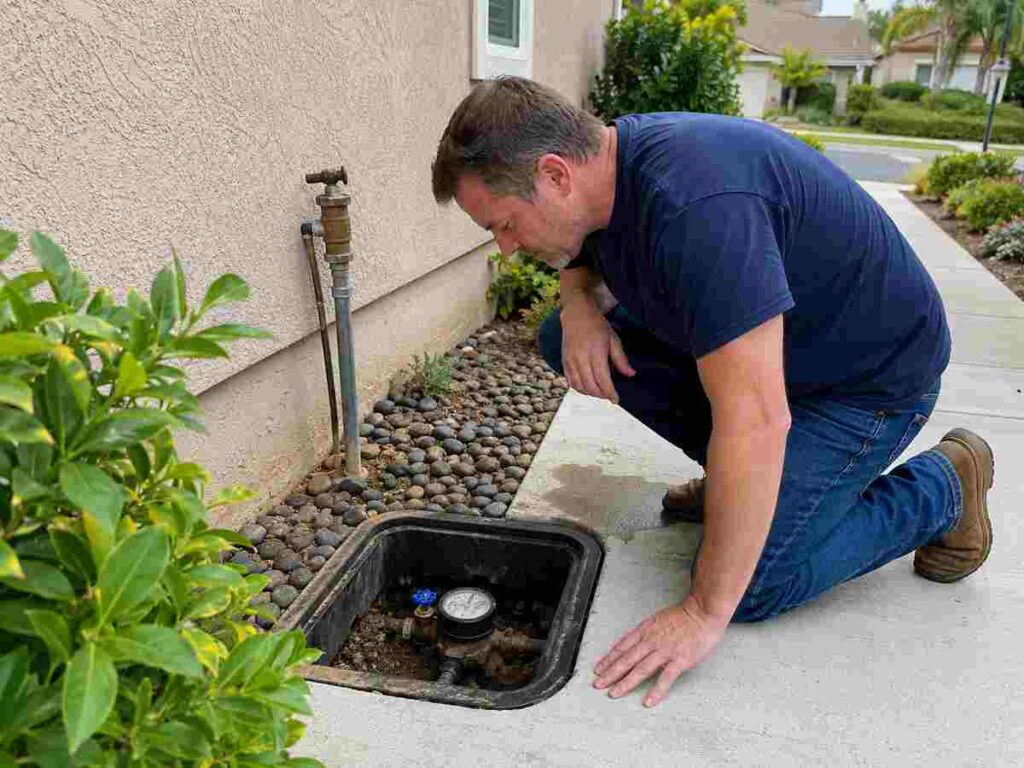
A supply line leak can also reduce usable water pressure.
You can perform an observational meter check.
First, turn off normal water use inside and outside the property.
Check faucets, toilets, irrigation, dishwasher, washing machine, refrigerator water supply, and other water using equipment.
Once intentional water use has stopped, observe the water meter.
If the meter continues registering flow, water may still be moving somewhere in the plumbing system.
The meter test does not tell you where the water is going, but it can help determine whether leak detection should become part of the next diagnostic step.
Signs the Pressure Regulator Deserves a Closer Look
The PRV becomes a stronger possibility when several clues appear together.
Every Fixture Has Weak Water Flow
The regulator supplies the entire house, so a regulator restriction typically influences multiple fixtures rather than one faucet.
Pressure Changed Quickly
A sudden house wide change points more strongly toward a shared component than slowly accumulating fixture scale.
Neighbors Have Normal Pressure
This helps separate your property’s plumbing from a neighborhood supply condition.
The Main House Valve Is Fully Open
Once a partially open valve has been ruled out, the regulator becomes more relevant.
Static Pressure and Flow Do Not Match
If static pressure seems reasonable but usable flow becomes very weak when water is running, investigate restrictions such as the regulator.
Pressure Changes Significantly With Fixture Use
Large changes as fixtures open and close can indicate that the plumbing system is having difficulty maintaining regulated pressure under demand.
Pressure Has Become Inconsistent
A regulator that responds inconsistently can produce noticeable changes from one period of water use to another.
When the PRV Is Probably Not the Main Cause
A good diagnosis also means knowing when to look elsewhere.
Only One Faucet Is Weak
Start with its aerator, cartridge, angle stop, and local supply connection.
Only One Shower Is Weak
Inspect the showerhead and shower valve components.
Only Hot Water Is Weak
Focus on the water heater and hot water distribution system.
Several Neighbors Have the Same Change
Investigate local utility conditions.
Pressure Has Slowly Reduced for Years
Older supply piping may be contributing to gradual flow restriction.
Pressure Changed Immediately After Filter Service
Check the filtration system and its valves.
The Water Meter Shows Continuous Flow With Everything Off
Leak detection becomes an important next step.
This process keeps the diagnosis focused on evidence rather than assumptions.
Could Older Pipes Cause Low Water Pressure?
Yes, especially when the change has been gradual.
Older galvanized steel piping can develop internal corrosion and mineral accumulation that reduce the usable interior diameter of the pipe.
The outside of the pipe may still appear substantial while the opening inside has become considerably smaller.
This typically creates a different pattern from a sudden PRV restriction.
Pipe restriction often appears as:
- Gradually weakening flow.
- Greater pressure reduction when multiple fixtures operate.
- Stronger flow at some fixtures than others.
- Older galvanized water supply piping.
- Increasingly limited water volume over time.
When pressure was strong one day and significantly weaker the next, begin with components capable of changing quickly before assuming the entire house needs new piping.
Should You Adjust the Water Pressure Regulator?
Some PRVs have an external adjustment mechanism, but turning the adjustment screw should not be treated as a universal solution.
An adjustment changes the regulator’s setting.
It does not automatically correct:
- Internal sediment
- A restricted valve seat
- A worn diaphragm
- A weakened spring
- Internal mineral accumulation
- An incorrectly sized regulator
- A separate plumbing restriction
If the regulator is mechanically healthy but simply set lower than desired, an appropriate adjustment may restore the intended pressure.
If internal components are restricting flow, changing the adjustment may provide little improvement.
Avoid disassembling a PRV while the plumbing system is pressurized. Testing first provides far more useful information than repeatedly turning the adjustment mechanism.
Why Replacing a PRV Can Restore Whole House Flow
When a regulator has an internal restriction, water entering the home must pass through a narrowed pathway.
Replacing the restricted regulator restores a properly sized pathway and allows the new valve to regulate incoming pressure correctly.
A complete PRV diagnosis should ideally consider:
- Incoming supply pressure.
- Regulated pressure after the PRV.
- Static pressure.
- Pressure while water is flowing.
- Available flow.
- Main shutoff valve condition.
- Service line condition.
- Signs of water leakage.
- Pipe material.
- Household water demand.
This helps confirm that the regulator is actually responsible before any component is replaced.
Why San Diego Water Pressure Can Differ From Home to Home
Two homes within the same city can experience different water pressure.
Municipal water systems operate through pressure zones, elevations, storage facilities, pumping equipment, distribution mains, and changing system demand.
A house at one elevation may therefore receive different incoming pressure from a house elsewhere in San Diego.
The City confirms that water pressure varies across San Diego depending on both location and demand.
This is one reason a functioning pressure regulator is important. It helps convert varying incoming pressure into a more consistent pressure suitable for the household plumbing system.
A Practical San Diego Water Pressure Troubleshooting Sequence
For homeowners who want a simple diagnostic order, use this sequence.
Step 1: Test More Than One Fixture
Determine whether the change is local or house wide.
Step 2: Compare Hot and Cold Water
This can isolate a water heater related restriction.
Step 3: Check With a Neighbor
This helps separate municipal pressure from property plumbing.
Step 4: Look at the Main House Shutoff
Confirm that an accessible household valve is in its normal open position.
Step 5: Review Recent Plumbing Work
Think about filters, water heaters, irrigation, remodeling, valve operation, or other recent service.
Step 6: Observe the Water Meter
With intentional water use stopped, check for unexplained water movement.
Step 7: Measure Static Pressure
Use a hose bib pressure gauge.
Step 8: Observe Pressure Under Demand
Run a fixture and note how much pressure and flow change.
Step 9: Evaluate the PRV
If the whole home remains affected and the municipal supply appears normal, the regulator becomes a strong diagnostic candidate.
This outside to inside approach helps locate the restriction instead of guessing.
How to Help Your Water Pressure Regulator Perform Reliably
A few simple habits can make household pressure changes easier to recognize.
Know Your Normal PSI
Take an occasional pressure reading when the plumbing is performing normally.
That gives you a baseline for comparison later.
Know Where Your PRV Is Located
A regulator is often installed near the point where the main water supply enters the property, though the exact location varies by home.
Know Where the Main House Shutoff Is Located
Being familiar with this valve is useful for both troubleshooting and routine plumbing maintenance.
Maintain Water Filters
Replace filtration media according to the equipment manufacturer’s schedule.
Pay Attention to Changes in Flow
A shower becoming noticeably weaker when another fixture opens can provide useful information before the condition becomes more pronounced.
Test Rather Than Guess
Pressure gauge readings, meter observations, fixture comparisons, and neighborhood comparisons provide better answers than replacing plumbing parts based only on appearance.
Related: How to Flush Your Water Heater to Remove San Diego Sediment: A Step by Step Guide
Final Takeaway
When your water pressure suddenly drops to a trickle, the most useful first question is not simply, “How do I increase my water pressure?” The better question is, “Where does the flow begin to change?”
Test one fixture versus the whole house. Compare hot water with cold water. Check whether neighboring homes are affected. Confirm the main house shutoff position. Observe the water meter. Measure static pressure. Then see how the system performs while water is flowing.
If the pressure change affects the entire property and the municipal supply appears normal, the water pressure regulator or PRV becomes one of the most important components to evaluate.
As experienced plumbers in San Diego, CA, we understand why this diagnostic sequence matters locally. San Diego water pressure varies by location and demand, and many properties rely on pressure reducing valves to deliver controlled pressure to household plumbing.
Understanding the difference between a fixture restriction, a flow restriction, municipal pressure, and a PRV issue helps homeowners reach the correct solution with far less guesswork.
Related: How to Clear a Stubborn Drain Clog Without Ruining Your Pipes?
Frequently Asked Questions
Why did my water pressure suddenly drop throughout the whole house?
A sudden whole house pressure change commonly points toward something shared by the entire water supply, such as the municipal supply, main shutoff valve, water pressure regulator, whole house filter, service line, or a significant plumbing leak.
Can a bad pressure regulator cause very low water pressure?
Yes. A water pressure regulator can restrict incoming flow if its internal components are no longer moving correctly or the valve becomes restricted. San Diego’s own utility guidance specifically lists a regulator that has moved toward the closed position as one possible source of decreased water pressure.
Can a PRV cause low water pressure throughout the house?
Yes. Because the pressure reducing valve is normally installed on the main incoming water line, a restriction there can influence faucets, showers, toilets, appliances, and other fixtures throughout the property.
Why does my water pressure drop when I turn on two faucets?
This frequently indicates that the plumbing system cannot maintain enough flow under increased demand. Potential causes include a restricted PRV, partially open main valve, loaded water filter, restricted service pipe, or aging distribution piping.
Static PSI and available flow should both be evaluated.
Why is my shower pressure low but my faucets are fine?
If the rest of the house has normal water pressure, inspect the showerhead, mineral deposits, flow restrictor, cartridge, and shower valve before focusing on the whole house regulator.
Why is my hot water pressure low but cold water pressure is normal?
When only hot water is affected, investigate the water heater shutoff valve, connectors, mixing components, tankless inlet screen where applicable, sediment, and hot water piping.
What PSI should I set my pressure regulator to?
There is no single perfect setting for every property. City PRV program guidance has used a range of approximately 45 to 75 PSI after regulation. The appropriate setting should also account for your home’s plumbing system and fixtures.
Can I test water pressure myself?
A homeowner can perform a basic observational test using a water pressure gauge attached to an appropriate hose bib. Turn off other water use, connect the gauge according to its instructions, open the hose bib, and record the PSI.
Avoid opening plumbing components or working on pressurized equipment simply to obtain a reading.
Can a water leak lower household pressure?
Yes. Water leaving the plumbing before reaching your fixtures can reduce the flow available elsewhere. A water meter that continues showing usage when all intentional water use is stopped is an important clue to investigate.
How do I know whether the city supply or my plumbing is responsible?
Check neighboring homes and contact the local water utility if necessary. San Diego Public Utilities can check pressure in the area, and the City states that when neighborhood pressure is normal, the source is most likely associated with plumbing on the property.
Does a pressure regulator always need replacement when pressure is low?
No. Testing should come first.
Low pressure can originate from the regulator setting, an internal regulator restriction, a main valve, a filter, the water service line, individual fixtures, a leak, or municipal supply conditions.
Accurate diagnosis helps determine the appropriate solution.