If your mainline drain keeps backing up no matter how many times it’s been cleared, the underlying cause is often a combination of aging clay pipe and tree roots working their way into the joints below your yard.
This is one of the most common plumbing issues we diagnose in older homes, and it deserves a proper explanation rather than another quick snake and a promise it won’t happen again.
Clay pipes and tree roots create a mainline drain problem that shows up again and again in neighborhoods where the original sewer lines have been sitting underground since before the 1960s.
Understanding why this happens, and why it tends to concentrate in specific pockets of the city, helps homeowners make a more informed decision the next time a drain starts running slow, which is exactly the kind of diagnosis our plumbing service in San Diego handles on a regular basis.
Why Historic Neighborhoods Face This Problem More Often?
Homes built before the 1960s were almost always connected to the street sewer using vitrified clay pipe, sometimes called clay tile.
At the time, clay was considered a reasonably durable material, and in many respects it still holds up structurally. The real weakness isn’t the clay itself, it’s how the pipe was installed.
Clay sewer lines were laid in short sections, typically two to four feet long, joined together with mortar or a simple hub and spigot connection.
Every one of those joints is a seam, and over sixty or more years in the ground, that seam naturally shifts slightly, develops a hairline gap, or loses its seal entirely. A gap that small might sound insignificant, but it’s more than enough for a root to find.
This is why the mainline drain problem shows up so consistently in older, established parts of the city rather than in newer developments built with modern PVC piping.
The pipe material and the installation era matter far more than the age of the home’s interior plumbing, and it’s also why a slow, gradual root intrusion can eventually turn into a burst pipe if the underlying joint damage is left unaddressed.
How Tree Roots Actually Get Into a Sewer Line
Roots don’t grow toward a pipe out of instinct. They grow toward moisture, and a sewer line carrying wastewater is a steady, reliable source of it, especially during dry stretches when surrounding soil offers little else.
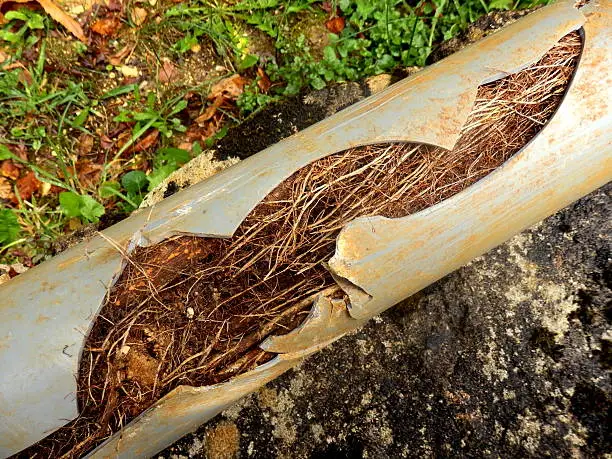
Once a root finds a gap at a clay pipe joint, it doesn’t need much room to get started. A thread thin root tip works its way through the opening, and once inside the pipe, it has access to warmth, moisture, and nutrients in one place.
From there, the root thickens, branches, and spreads along the interior wall of the pipe. Within a couple of seasons, what started as a small intrusion becomes a dense mass that catches toilet paper, grease, and debris every time the line is used.
This is why a mainline that clears with snaking but backs up again within weeks usually isn’t dealing with a simple clog.
It’s dealing with root regrowth at the same joint, and the underlying gap needs to be addressed directly rather than treated as a recurring inconvenience, which is where a proper sewer line repair makes the difference between a temporary fix and a lasting solution.
The Trees Behind Most of San Diego’s Root Intrusion Cases
Not every tree poses the same level of risk to a clay sewer line. Species with aggressive, wide spreading root systems cause the overwhelming majority of the intrusion cases we see, and several of them happen to be common in the mature, tree lined streets of San Diego’s older neighborhoods.
Ficus trees, including strangler fig and Indian laurel fig varieties, are among the most persistent offenders due to their fast, far reaching root growth.
Eucalyptus trees send extensive root systems well beyond their canopy line, often much further than homeowners expect.
Jacaranda trees, a familiar sight on many older streets, are a beloved part of the local landscape but are also a frequent contributor to clay joint intrusion.
Moreton Bay figs and mature willows round out the list, both known for aggressive, moisture seeking root behavior.
Neighborhoods with this kind of mature tree canopy sitting directly above decades old clay laterals create close to ideal conditions for the mainline drain problem to develop, even in homes where the interior plumbing has been fully updated.
Signs a Root Intrusion Issue Is Developing
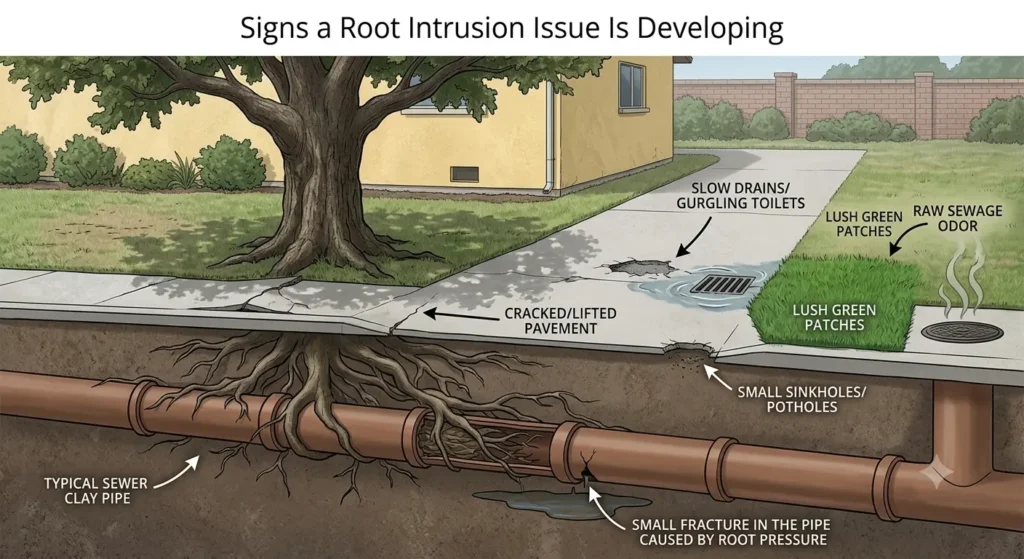
Most mainline problems don’t appear overnight. There are usually a few earlier signals worth paying attention to before a full backup happens.
- Multiple drains in the home running slowly at the same time, rather than just one fixture.
- A gurgling sound from toilets or drains shortly after use.
- A sewer odor near the yard where the lateral runs toward the street.
- The same blockage returns within weeks of a professional cleaning.
- Small dips or unusually lush patches of grass forming along the path of the sewer line.
A single slow drain is often isolated to that fixture. When several drains act up together, the issue is almost always further down the line, at or near the mainline itself.
Related: How San Diego Hard Water Destroys Tankless Water Heaters Over Time
Why a Camera Inspection Comes Before Any Repair Decision
Guessing at what’s happening underground rarely leads to the right fix. A sewer camera inspection allows a technician to see the actual condition of the clay pipe, including exactly where roots have entered, whether joints have separated, and whether the pipe has developed a low spot or belly where debris continues to collect even after roots are cleared.
This step matters because two homes with the same symptom, a recurring backup, can have completely different underlying conditions. One may need a straightforward root cutting and a maintenance schedule going forward.
Another may have a section of pipe that’s cracked or offset enough that repeated cleaning will only offer a temporary fix. A camera inspection removes the guesswork and lets the homeowner make a decision based on what’s actually happening below the surface rather than assumptions.
Repair Options for Clay Pipe and Root Intrusion
Once the condition of the line is confirmed, there are a few paths forward depending on severity.
Hydro jetting clears root masses and buildup thoroughly using high pressure water, and is often the right choice when the pipe itself is still structurally sound.
Root cutting combined with a maintenance schedule works well for homes where intrusion is present but the joints haven’t significantly deteriorated, particularly when paired with periodic camera checks.
Trenchless pipe lining, sometimes called cured in place pipe or CIPP, creates a new, jointless pipe inside the old clay line. Because there are no seams left for roots to exploit, this option directly addresses the root cause rather than managing the symptom, and it does so without the extensive excavation that traditional pipe replacement requires, which matters a great deal for homes with mature landscaping or a driveway sitting above the line.
Traditional excavation and replacement remains necessary in some cases, particularly where a section of clay pipe has collapsed or shifted too far out of alignment for lining to be effective.
Related: How San Diego’s Winter Storms Trigger Underground Sewer Line Backups
Protecting Older Homes Going Forward
For homeowners in older, established neighborhoods, a proactive approach tends to save far more money and stress than a reactive one.
A routine camera inspection every year or two, especially for properties with mature trees near the lateral path, catches root intrusion while it’s still a manageable maintenance item rather than an emergency backup on a weekend evening.
Clay pipes and tree roots will likely remain a factor in these neighborhoods for as long as the original lines stay in the ground, but the mainline drain problem doesn’t have to mean repeated disruption.
With the right inspection and the right repair approach matched to the actual condition of the pipe, a decades old clay lateral can be brought back to reliable, long term performance.
Related: Why Slab Leaks Are Disrupting Homes in El Cajon and Oceanside?
Frequently Asked Questions
Why do older homes have more sewer line problems than newer homes?
Older homes were typically connected with vitrified clay pipe installed in short, jointed sections, and those joints naturally develop small gaps over decades, creating entry points for tree roots that newer, jointless PVC or HDPE lines don’t have.
How can I tell if tree roots are in my sewer line?
Common signs include multiple slow drains at once, gurgling sounds from toilets or drains, a sewer odor near the yard, and a blockage that returns shortly after professional cleaning.
Does cutting down the tree solve the root intrusion problem?
Not entirely. Roots already inside the pipe often continue growing even after a tree is removed, so addressing the pipe itself, either through lining, spot repair, or replacement, is usually still necessary.
Is trenchless pipe lining a permanent fix for root intrusion?
Yes, in most cases. Because lining creates a smooth, jointless pipe inside the old line, there are no remaining gaps for roots to exploit, which makes it one of the most durable long term solutions available.
How often should an older home get a sewer camera inspection?
Every one to two years is a reasonable baseline for homes with clay or cast iron laterals, especially those with mature trees growing near the lateral path.
Can chemical drain cleaners get rid of tree roots in a sewer line?
Store bought chemical treatments rarely clear root masses effectively and can contribute to pipe corrosion over time, so a professional camera inspection and mechanical or hydro jetting approach is generally the safer and more effective route.