Our licensed plumbing specialists use advanced leak detection technology to locate the exact source of the problem without unnecessary digging or damage to your floors. Instead of guessing where the leak may be, we use precise equipment designed to identify under-slab pipe failures quickly and efficiently. Once the leak is located, we explain the issue clearly, walk you through all available repair options, and provide upfront pricing before any work begins.
Whether your home has aging copper pipes, corrosion-related leaks, shifting foundation damage, or burst water lines beneath the slab, our experienced technicians are equipped to handle the repair properly the first time. We offer targeted pipe repairs, rerouting solutions, and full repiping recommendations when needed, always focusing on the most cost-effective and long-lasting solution for your home.
Homeowners across San Diego count on us because we respond quickly, communicate honestly, and treat every property with care throughout the repair process. From the initial inspection to the final repair, our goal is to minimize disruption, protect your home, and restore your plumbing system as fast as possible. When you need dependable slab leak repair in San Diego CA, our team delivers licensed expertise, accurate detection, and lasting results without the stress or uncertainty.
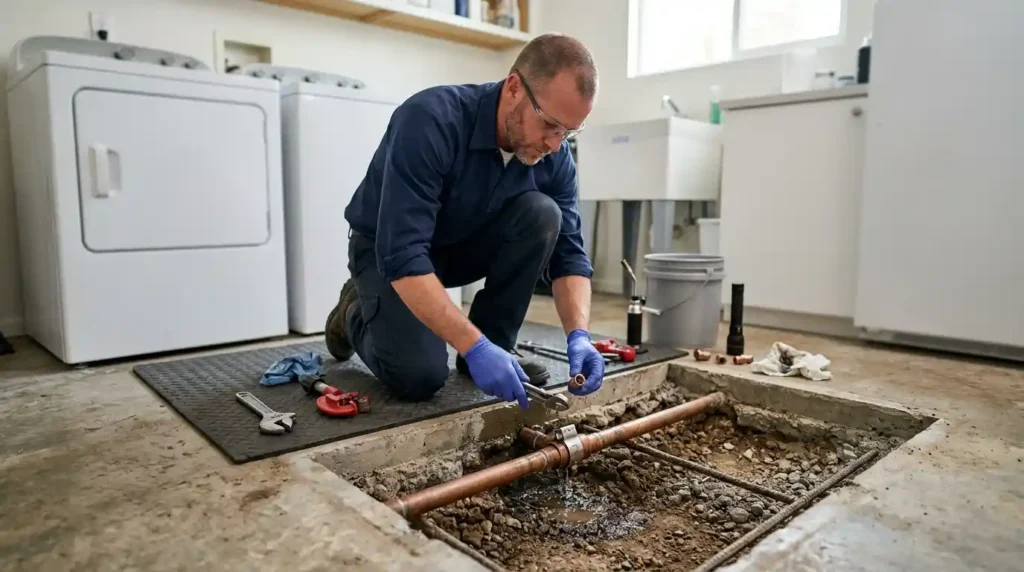
A slab leak is a leak that occurs in the water supply or drain pipes running beneath or within the concrete foundation of your home. When San Diego homes are built on a concrete slab, plumbers route hot and cold water lines directly through or underneath that concrete. Over time, those pipes can corrode, shift, crack, or develop pinholes. When they do, water escapes into the soil or upward through the slab, and the damage compounds quietly until something noticeable gives it away.
Because the affected pipes are buried under several inches of concrete, slab leaks are genuinely difficult to detect without the right equipment. That is why they are also one of the most underestimated threats to a San Diego home. By the time you notice a problem on the surface, water has often been migrating for weeks or months, quietly softening soil, encouraging mold growth behind baseboards, and stressing your foundation from beneath.
San Diego is particularly vulnerable to this type of plumbing failure. The region sits in a seismically active zone where minor ground movement is routine. Soil in many parts of the county expands and contracts with seasonal moisture changes. Older neighborhoods throughout the city, many of which were built in the 1950s and 1960s, still carry their original copper plumbing, which has had decades to corrode. All of these factors combine to make slab leak repair in San Diego CA one of the most commonly needed plumbing services in the area.
Slab leaks rarely announce themselves directly. Instead, they leave a trail of indirect clues that are easy to dismiss individually but become hard to ignore once you know what to look for. Here is what homeowners should watch for.
This is the most common first indicator. If your monthly water usage from SDG&E or the City of San Diego has climbed noticeably but your household habits have not changed, water is escaping somewhere in your system. A slab leak that has been running for several weeks can waste thousands of gallons and add hundreds of dollars to your utility costs.
If you hear water moving inside walls or floors when every faucet, appliance, and toilet in the home is completely off, that sound is coming from a pressurized leak somewhere in your supply lines. Under-slab leaks frequently create this effect because the water has no easy escape path and travels through the concrete itself, producing a faint hissing or rushing sound.
Hot water line slab leaks are especially telling because the escaping water heats the slab above it. Walking across a tile or hardwood floor and suddenly encountering a noticeably warm patch is a reliable sign that a hot water line below has failed. Many San Diego homeowners first notice this barefoot in their hallway or bathroom.
If carpet, hardwood, or tile near the base of walls feels damp and there is no rain, spill, or plumbing fixture nearby to explain it, water is likely wicking upward from below. This is particularly common in homes with older foundations where the concrete has developed hairline cracks that give moisture a path to the surface.
Water from a prolonged slab leak erodes and shifts the soil beneath the foundation. As that soil destabilizes, the foundation moves, and cracks appear in walls, door frames, tile grout lines, and the floor itself. These are not cosmetic problems. They are structural symptoms of ongoing water damage and should be taken seriously.
A significant supply line leak below the slab bleeds pressure from the entire system. If your shower pressure has dropped across multiple fixtures simultaneously and nothing else in the home explains it, a slab leak is one of the first things a licensed plumber will investigate.
Persistent moisture below and within your floors creates the ideal environment for mold colonies to develop inside walls, under baseboards, and beneath flooring materials. A musty smell that seems to come from the floor itself rather than from a bathroom or laundry area is a strong indicator that moisture has been accumulating in your foundation zone for some time.
One of the biggest anxieties homeowners have about slab leak work is the prospect of crews tearing up beautiful tile floors, hardwood finishes, or carpeted bedrooms to find a pipe somewhere underneath. The good news is that modern detection technology has largely eliminated the need for exploratory demolition.
Our technicians use a combination of professional-grade methods to locate leaks precisely before any access work begins.
The goal of all of this technology is the same: find the exact location of the problem before breaking concrete, so that the access we do make is targeted, minimal, and made in the right place the first time.
Once the leak is precisely located, the appropriate repair method depends on several factors, including the pipe’s material, the age of your overall plumbing system, the location of the leak relative to your finished floors, and whether the failure appears to be isolated or part of a broader corrosion pattern throughout the system. Here is an honest overview of the options.
Spot Repair (Direct Access)
For an isolated leak in an otherwise healthy pipe, a spot repair is often the most cost-effective and least disruptive option. We access the slab directly above the leak, remove a targeted section of concrete, repair or replace the damaged pipe section, and restore the concrete. This method works well when the surrounding plumbing is in good condition and the leak is a genuinely singular event rather than a symptom of widespread deterioration.
Pipe Rerouting
When a pipe is severely corroded, has failed multiple times, or runs through a particularly difficult area of the slab to access, rerouting is frequently the better long-term decision. Rather than opening the concrete, we bypass the damaged underground section entirely by running a new pipe line through your walls or ceiling to reconnect the same fixtures. This eliminates the problematic section from service permanently without requiring extensive concrete work. It is a particularly strong option for homes where the original copper lines are reaching end of life.
Epoxy Pipe Lining
For situations where a pipe has developed multiple small leaks and direct access or rerouting is impractical, epoxy lining is a minimally invasive alternative. A flexible liner coated with high-strength epoxy resin is inserted into the existing pipe and cured in place, essentially creating a new pipe interior within the old one. This method is best suited for pipes that are still reasonably intact but have developed pinhole corrosion along their length.
Whole-House Repiping
When a home’s plumbing has aged to the point where slab leak failures are occurring regularly, or when an inspection reveals corrosion throughout multiple lines, a full repipe is the most comprehensive and ultimately most economical solution. We replace the entire supply system using modern PEX or copper materials routed through walls and above the slab, ending the cycle of recurring under-slab failures. For many San Diego homes built in the 1950s and 1960s that still carry their original galvanized or early copper plumbing, this is the repair that finally solves the problem once and for all.
This section exists because a meaningful number of homeowners call us after having noticed signs for weeks or months and deciding to wait and see. The outcome is almost always more expensive than an earlier call would have been.
Water from a slab leak does not stay put. It migrates through the path of least resistance, which typically means upward through the slab and into your subfloor, outward into the surrounding soil, and eventually into your walls. The longer it runs, the larger the zone of moisture damage becomes.
Mold is one of the most significant consequences of a delayed response. Once moisture has been present in wall cavities and under flooring for an extended period, mold colonies establish quickly. Remediation for mold that has spread through a finished area of a home is expensive, disruptive, and sometimes requires demolition and reconstruction of affected surfaces beyond anything the original plumbing repair would have touched.
Structural damage is the more severe long-term risk. Persistent water migration beneath a concrete slab erodes supporting soil, creates voids, and destabilizes the foundation above it. Foundation repairs in San Diego run into the tens of thousands of dollars. A slab leak caught and repaired while it is still a plumbing problem costs a fraction of what it costs once it has become a structural problem.
The message is simple. If you have recognized the signs, call a licensed plumber who specializes in slab leak detection. The cost of acting now is consistently and significantly lower than the cost of waiting.
Pricing is always one of the first questions homeowners ask, and any contractor who gives you a firm number before seeing your home is not being straight with you. The honest answer is that cost depends on the location of the leak, how deep the pipe sits in the slab, how finished the surrounding surfaces are, and which repair method is appropriate for your specific situation.
That said, here is a realistic overview of what San Diego homeowners typically pay based on current market data.
For San Diego specifically, current market pricing looks roughly like this:
A few specific repair scenarios to help you plan:
Most standard homeowners insurance policies in California cover the cost of accessing the leak, meaning the concrete demolition, but do not cover the pipe repair itself. Insurance may also cover resulting water damage to flooring and walls depending on your specific policy. We work regularly with homeowners navigating insurance claims and can provide the documentation and photographs your adjuster needs to process the claim efficiently.
There are dozens of plumbing companies in San Diego County advertising slab leak services. Here is what genuinely differentiates the kind of service that actually protects your home and your budget.
You receive a detailed written quote before any work begins. No open-ended estimates, no surprise charges at invoice time. The price we quote is the price you pay for the scope we agreed on.
All of our plumbers carry current California state plumbing licenses and work under full liability and workers' compensation insurance. We handle all required City of San Diego and county permits for qualifying work, ensuring your repair is inspected and code-compliant.
We stand behind our repairs. If something goes wrong with work we performed, we come back and correct it at no additional charge. That commitment is not a marketing phrase. It is how we have built our reputation in this city.
Slab leaks are not a wait-until-Monday situation. Water damage compounds by the hour. Our team is available around the clock for emergency detection and repair calls throughout San Diego County.
We tell you what the problem actually is and what your realistic options are. If a spot repair is genuinely the right call, we say so. If the state of your plumbing makes a full repipe the smarter long-term investment, we explain why with evidence rather than pressure. You make the decision with complete information.
We do not guess at leak locations and we do not do exploratory demolition. Every job begins with acoustic sensors, thermal imaging, and pressure testing to pinpoint the leak's exact position before access work begins. That precision protects your floors and keeps your repair cost as low as the problem allows.
This is one of the most frequently asked questions we hear, and the answer requires some nuance. The coverage landscape varies significantly depending on your policy and provider, so the guidance below is general rather than advice specific to your situation.
Most standard California homeowners insurance policies cover sudden and accidental damage. A pipe that fails abruptly and causes measurable damage to flooring, walls, and other surfaces typically qualifies as a covered event. The cost of accessing the leak, meaning breaking up the concrete, is often covered. The pipe repair itself is often not covered because it is considered a maintenance issue. Resulting water damage to finished surfaces may be covered under your dwelling coverage.
Gradual leaks are where coverage becomes more complicated. Insurers often deny claims for slow leaks that could have been discovered earlier with reasonable attention, arguing that the damage was not sudden or accidental in the way most policies require.
If you suspect your insurance may apply, take photographs of everything before any work begins, contact your agent to start the claims process before the repair is completed, and work with your plumber to ensure all documentation is preserved. We are experienced in providing the written reports and photo documentation that San Diego-area insurance adjusters require for slab leak claims.
Our licensed plumbing technicians respond to slab leak calls across the full span of San Diego County, including:
Mission Hills, North Park, South Park, Kensington, Normal Heights, University Heights, Hillcrest, Mission Valley, Linda Vista, Clairemont, Bay Park, Pacific Beach, Ocean Beach, Point Loma, La Jolla, Carmel Valley, Del Mar, Solana Beach, Encinitas, Carlsbad, Oceanside, Vista, San Marcos, Escondido, Poway, Rancho Bernardo, Scripps Ranch, Santee, El Cajon, La Mesa, Lemon Grove, Spring Valley, National City, Chula Vista, and Bonita.
If your neighborhood is not listed here, call us. We cover all of San Diego County and have worked in homes of every era and construction type across the region.
The sooner a slab leak is found, the less it costs to fix, and the less damage your home sustains. If you have noticed any of the warning signs described on this page, or if you simply want the peace of mind that comes from a professional inspection of your foundation-level plumbing, our team is ready to help you today.
Call us now for same-day service, or use our online booking tool to schedule at the time that works best for you. We will confirm your appointment, arrive with the detection equipment your situation requires, and give you a clear picture of what is happening under your home along with your best options for addressing it.
Call Now for Same-Day Detection and Repair Free Estimates | 24/7 Emergency Response | All of San Diego County
The combination of an unexplained water bill increase, a sound of running water when all fixtures are off, and warm or wet spots on the floor is highly specific to slab leaks. A licensed plumber with proper detection equipment can confirm the diagnosis within the first visit.
In most cases, yes. Spot repairs and rerouting work are targeted enough that most of your home remains fully functional during the process. Your water will be shut off during active work periods and restored at the end of each working day.
We use non-invasive detection technology specifically to minimize the area of concrete we need to access. When floor access is necessary, we document the existing surface condition beforehand and provide recommendations for restoration following the plumbing work. The concrete and flooring repairs are part of completing the job properly.
It can be a meaningful signal, particularly in neighborhoods with similar construction vintage and plumbing materials. If your home was built in the same era as your neighbor’s, has the same original plumbing material, and sits on similar soil, a proactive inspection is a reasonable precaution.
Hot water line leaks are easier to detect because they create thermal signatures on the floor above them and cause your water heater to run almost continuously as it tries to compensate for the loss. Cold water line leaks are quieter thermally but still show up clearly with acoustic detection equipment. Both require the same care and precision in repair.

Providing reliable plumbing services throughout San Diego County, we deliver honest pricing, quality workmanship, and 24/7 emergency support for homeowners and businesses.
Copyright © 2026 Plumbero. All rights reserved.