
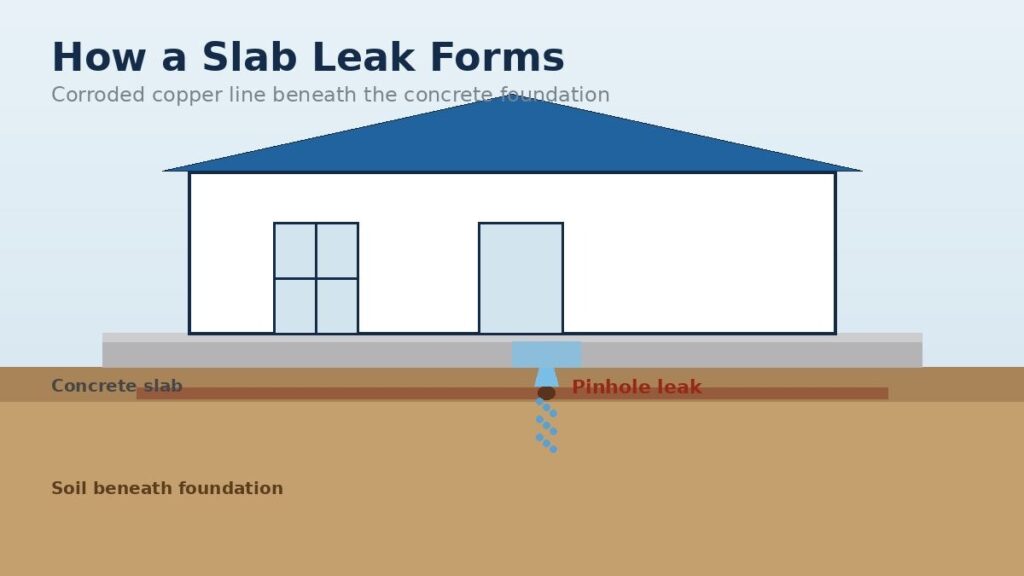
Slab leaks are disrupting homes across El Cajon and Oceanside because copper supply lines buried under the concrete foundation are corroding, shifting, and wearing through faster than most homeowners expect, and our licensed plumbing team provides slab leak detection and repair throughout San Diego County to stop the damage before it spreads.
If your floor feels warm in one spot, your water bill jumps without warning, or you hear water running when every fixture is off, a slab leak is very likely the cause, and it deserves prompt attention.
A slab leak happens when a pressurized water line running beneath your home’s concrete slab develops a crack or pinhole. Because the pipe is hidden under the foundation, the leak can continue for weeks before any visible sign reaches the surface.
By the time water stains appear on flooring or drywall, the leak has often been active far longer than most homeowners realize. This is exactly why slab leaks are disrupting homes in El Cajon and Oceanside at a rate that surprises so many local residents.
Why Are El Cajon and Oceanside Homes Especially Vulnerable?
Both cities sit on ground that puts extra stress on buried plumbing. El Cajon’s inland valley location means homes experience wider temperature swings and denser clay soil that moves with the seasons.
Oceanside’s coastal position adds a second factor: hard water and salt laden air that accelerate corrosion in copper piping, especially in homes built between the 1960s and 1980s when copper supply lines were run directly through the slab.
Several conditions combine to create the risk:
- Hard water mineral buildup that wears down pipe walls from the inside.
- Copper pipes reaching or exceeding their 40 to 50 year service life.
- Soil movement that stresses joints and fittings at bends in the line.
- High water pressure that adds ongoing strain to aging copper.
- Original construction techniques that placed pipes in direct contact with concrete, allowing electrolysis to eat through the metal over time.
Homeowners in older tract neighborhoods of El Cajon and established Oceanside communities near the coast tend to see this issue more often simply because their homes were built during the decades when this plumbing method was standard practice.
Signs Your Home May Have a Slab Leak
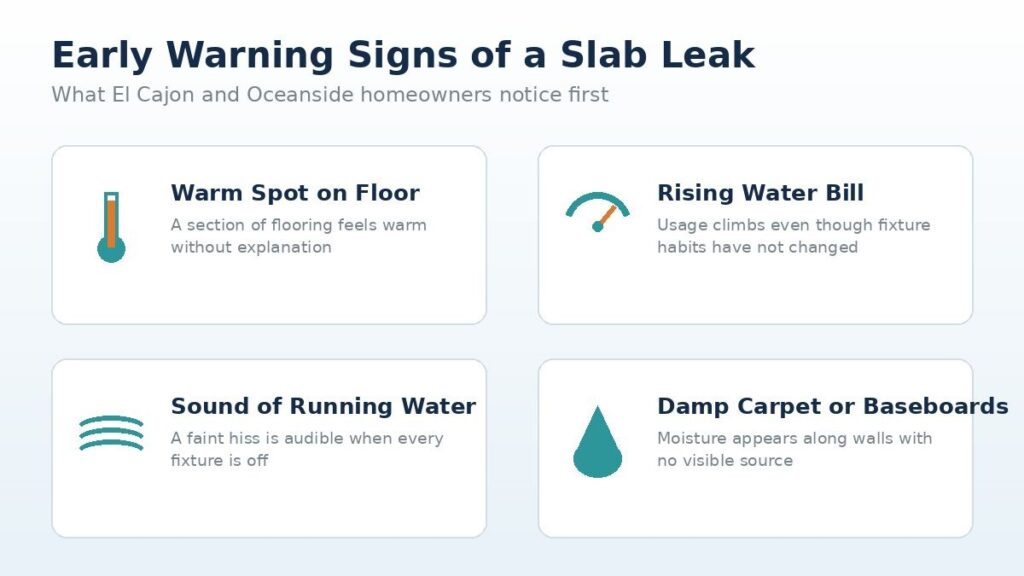
Catching a slab leak early keeps repair costs down and protects your flooring, cabinetry, and foundation from lasting damage. Watch for these signals:
- A warm or damp patch on the floor that has no obvious explanation.
- A water bill that climbs noticeably even though household usage has not changed.
- The sound of running water when every faucet, toilet, and appliance is off.
- Cracks appearing in flooring, tile grout, or nearby walls.
- A musty smell or the appearance of mold near baseboards.
- Reduced water pressure at fixtures throughout the home.
If any of these sound familiar, a professional inspection can confirm the source before the situation grows into a larger repair.
How We Locate and Repair Slab Leaks?
Our team uses non-invasive detection methods designed to pinpoint the exact leak location without unnecessary demolition.
This includes acoustic listening equipment that amplifies the sound of escaping water through the concrete, thermal imaging that maps temperature differences created by a leaking hot water line, and pressure testing that confirms the affected section of pipe.
Once the leak is located within inches, we walk homeowners through the most practical repair path, whether that means a spot repair, a reroute above the slab, or a full repipe for homes with aging plumbing throughout.
Explaining Soil Shifting in the Valley Areas and How Hidden Foundation Leaks Develop
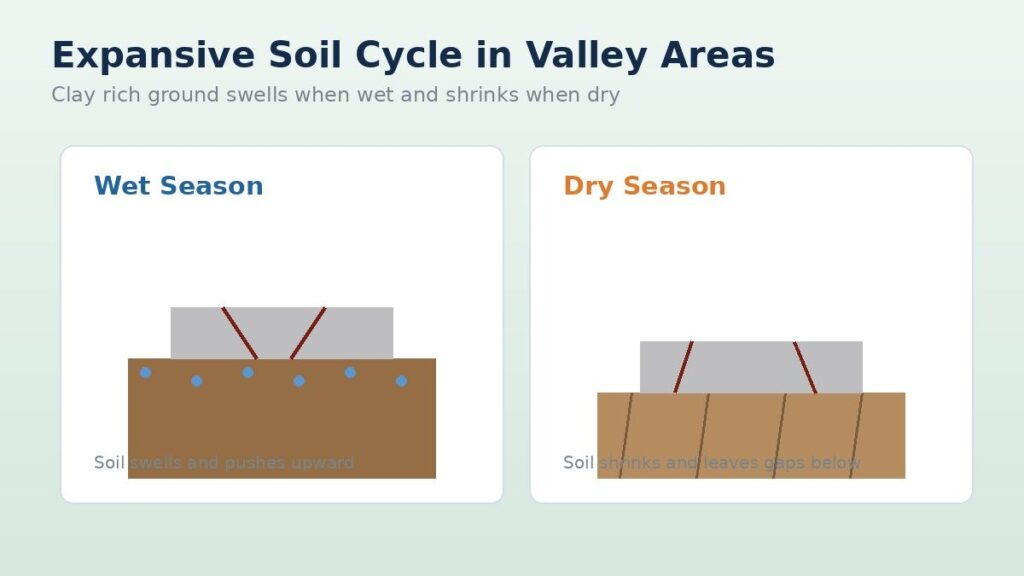
Soil shifting in the valley areas around San Diego County happens because much of the region sits on clay rich, expansive soil that swells when it absorbs moisture and shrinks again once it dries out.
This constant cycle of expansion and contraction is one of the leading reasons hidden foundation leaks develop in inland communities like El Cajon, where seasonal rainfall followed by long dry stretches puts repeated pressure on everything buried beneath the home.
Here is how the cycle plays out beneath a typical valley home:
The Wet Season Effect
When winter rains soak into the ground, clay particles in the soil absorb water and expand, in some cases increasing in volume by up to ten percent. This swelling pushes upward against the foundation and the pipes running beneath it, placing stress on joints, elbows, and connections that were never designed to flex.
The Dry Season Effect
As the weather turns dry through spring and summer, the same clay soil releases its moisture and contracts. This shrinking can leave small voids beneath sections of the slab, removing the support the foundation depends on.
Pipes that were pushed one direction during the wet months now settle differently, and the repeated back and forth motion gradually weakens fittings and creates the pinhole leaks that develop into full slab leaks.
Why Does This Matters for Foundation Health?
Over years of this swell and shrink pattern, the ground beneath a home is rarely still. Add in California’s frequent minor seismic activity, and buried pipes experience a slow, ongoing shearing effect at their weakest points.
Homes without proper drainage systems directing water away from the foundation tend to see this soil movement intensify, since pooling water saturates the ground unevenly and accelerates the expansion and contraction cycle right where it can do the most damage.
Good drainage practices, including gutters that discharge well away from the foundation and grading that slopes water away from the home, help reduce how dramatically the soil beneath your slab moves each season.
Still, no drainage system eliminates the natural clay content of the ground itself, which is why homes throughout El Cajon’s valley neighborhoods remain more prone to hidden foundation leaks than homes built on more stable soil types.
Related: Galvanized Steel Corrosion: What Older San Diego Homeowners Need to Know
Local Expertise You Can Rely On

We are proud to be recognized as the most experienced plumbing team in San Diego CA when it comes to slab leak detection and repair.
Our technicians have spent years working specifically within El Cajon’s clay heavy valley terrain and Oceanside’s coastal corrosion conditions, which means we understand the local causes behind these leaks rather than applying a generic approach.
Every inspection includes a clear explanation of what we find, straightforward repair options, and documentation that can support an insurance claim if needed.
Homeowners across San Diego County trust our team because we combine advanced detection technology with the kind of hands-on local knowledge that only comes from working these neighborhoods day after day.
Related: Clay Pipes and Tree Roots: The Mainline Drain Problem in San Diego
Frequently Asked Questions
What causes slab leaks in El Cajon and Oceanside homes?
Slab leaks are typically caused by a combination of aging copper pipes, hard water corrosion, expansive clay soil movement, and high water pressure. Oceanside’s coastal air adds salt exposure that speeds up corrosion, while El Cajon’s inland clay soil adds seasonal shifting stress.
How does soil shifting lead to a hidden foundation leak?
Clay rich soil expands when wet and contracts when dry. This repeated movement stresses the joints and fittings of pipes buried beneath the slab, and over time the stress creates small cracks or pinholes that grow into full leaks.
How can I tell if I have a slab leak?
Common signs include a warm spot on the floor, an unexplained rise in your water bill, the sound of running water when everything is off, and new cracks in flooring or nearby walls.
Is slab leak repair always invasive?
No. Modern acoustic listening equipment, thermal imaging, and pressure testing allow technicians to pinpoint a leak within inches, which usually limits the amount of concrete that needs to be opened.
Why are homes built between the 1960s and 1980s at higher risk?
Many homes from this era used copper piping run directly through the slab, and that copper is now approaching or past its typical 40 to 50 year service life, making pinhole corrosion far more likely.